
Why Are DSTs Becoming Popular Among Texas Childcare Property Owners?
As childcare property values rise and more owners approach retirement, Delaware Statutory Trusts (DSTs) are emerging as a powerful 1031 exchange strategy to help defer taxes, generate potential passive income, and eliminate property management responsibilities.
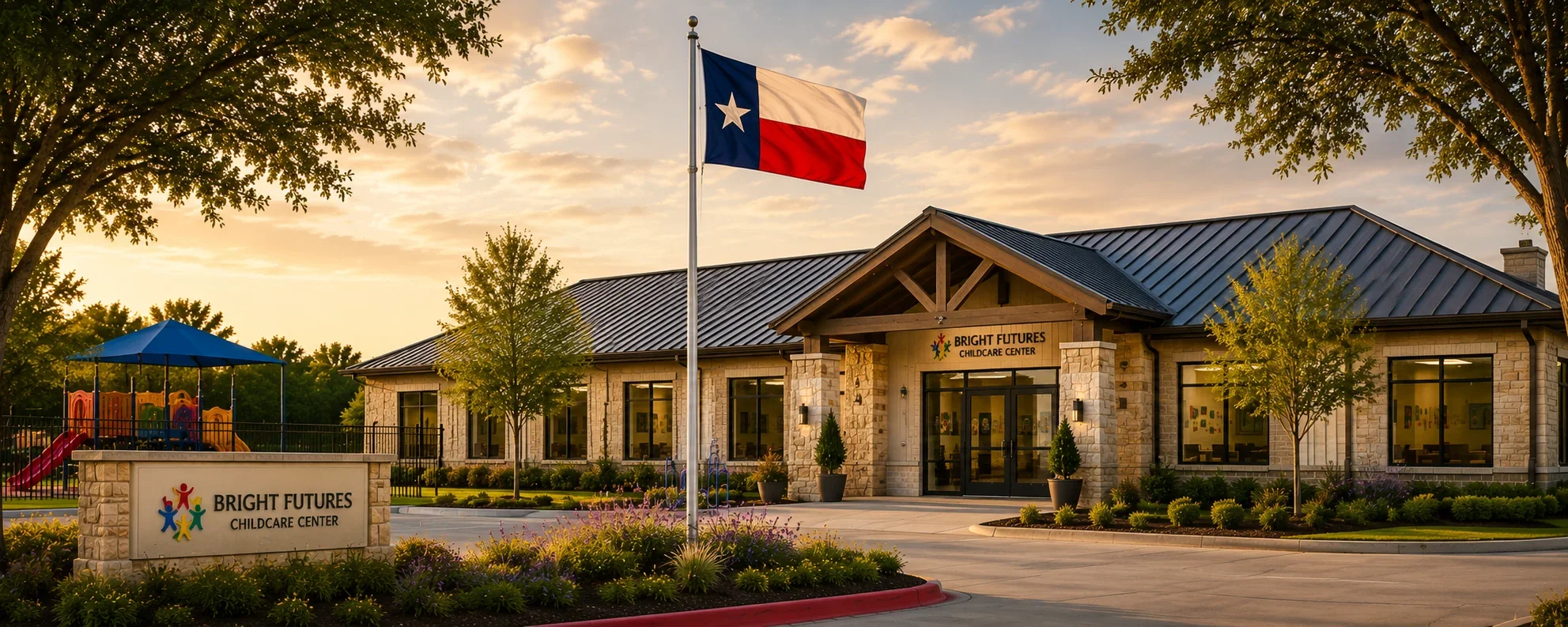
Owning a childcare facility is about much more than real estate. For many Texas preschool and daycare owners, their property represents decades of hard work, sacrifice, and commitment to serving children and families in their communities. In many cases, the real estate has become one of the largest assets they own.
As retirement approaches—or as operators begin evaluating succession plans—many childcare owners face difficult questions. Should they continue managing the property? Is there a family member ready to take over? What happens to the tax burden when the property is sold?
Across Texas, a growing number of childcare property owners are discovering that a Delaware Statutory Trust (DST) may offer a powerful alternative. By utilizing a properly structured 1031 exchange into a DST, owners may be able to defer capital gains taxes, eliminate management responsibilities, diversify their holdings, and create potential passive income for retirement.
Why Are More Childcare Property Owners Considering DSTs?
Texas continues to experience strong population growth and increasing demand for childcare services. As a result, many childcare properties have appreciated significantly in value over the past decade.
While rising property values can create substantial wealth, they can also create substantial tax liabilities when a property is sold. Federal capital gains taxes, depreciation recapture, and other taxes can significantly reduce the proceeds available to the owner.
A Delaware Statutory Trust offers a potential solution.
Through a properly executed 1031 exchange, childcare property owners may be able to:
Defer capital gains taxes and depreciation recapture.
Transition from active property ownership to passive real estate ownership.
Diversify into multiple institutional-quality real estate assets.
Eliminate tenant, maintenance, and management responsibilities.
Generate potential monthly income from professionally managed properties.
Simplify estate planning by converting a single property into fractional ownership interests.
For many owners, a DST provides an opportunity to preserve wealth while reducing the responsibilities that often come with owning commercial real estate.
How Can a DST Help Childcare Owners Transition Into Retirement?
Many preschool and daycare operators have spent years balancing the demands of running a business while managing the real estate underneath it. Even after selling the operating business, owners often remain responsible for the property itself.
A DST can provide a path toward a more passive lifestyle.
Instead of purchasing another property and continuing to manage tenants, maintenance, insurance, and repairs, owners become fractional owners in professionally managed institutional real estate. These properties may include:
Multifamily apartment communities
Medical office buildings
Industrial and logistics facilities
Self-storage properties
Grocery-anchored retail centers
Other income-producing commercial real estate
Professional management companies handle the day-to-day operations, allowing investors to focus on retirement, family, travel, ministry, or other personal priorities.
How Does Parry Financial Help Texas Childcare Property Owners?
At Parry Financial, we specialize in helping childcare property owners understand their 1031 exchange and DST options.
We recognize that selling a childcare property is rarely just a financial transaction. It often represents the culmination of a lifetime of work and service to children, families, employees, and the local community.
Our role is to help you evaluate your options, understand the potential benefits and risks of DST investments, and determine whether a DST strategy aligns with your financial goals.
We work alongside a network of experienced professionals, including:
Qualified Intermediaries (QI)
Certified Public Accountants (CPAs)
Estate Planning Attorneys
Real Estate Professionals
DST Sponsors and Investment Managers
This collaborative approach helps ensure that every aspect of your transition is coordinated and aligned with your long-term objectives.
Why Does Trust Matter When Considering a DST?
A 1031 exchange is often a once-in-a-lifetime event. The decisions made during this process can affect your retirement income, estate planning, tax strategy, and financial legacy for years to come.
That is why education and transparency are essential.
At Parry Financial, we believe our responsibility is not to pressure clients into investments but to help them make informed decisions. We take time to explain how DSTs work, discuss potential risks and rewards, and provide the information you need to determine whether a DST is appropriate for your situation.
Our goal is to help you move forward with confidence and clarity.
Preserve the Value You've Worked So Hard to Build
Selling your childcare property does not have to mean writing a large check to the IRS or taking on the burden of managing replacement properties.
With the right strategy, a Delaware Statutory Trust may allow you to defer taxes, diversify your holdings, generate potential passive income, and simplify your financial future.
If you are considering selling a childcare property in Texas, now is the time to explore your options and learn whether a DST strategy may be right for you.
Contact Parry Financial today to schedule a confidential consultation and discuss your 1031 exchange opportunities.
Which counties in Texas do we serve?
-
Anderson, Andrews, Angelina, Aransas, Archer, Armstrong, Atascosa, Austin, Bailey, Bandera, Bastrop, Baylor, Bee, Bell, Bexar, Blanco, Borden, Bosque, Bowie, Brazoria, Brazos, Brewster, Briscoe, Brooks, Brown, Burleson, Burnet, Caldwell, Calhoun, Callahan, Cameron, Camp, Carson, Cass, Castro, Chambers, Cherokee, Childress, Clay, Cochran, Coke, Coleman, Collin, Collingsworth, Colorado, Comal, Comanche, Concho, Cooke, Coryell, Cottle, Crane, Crockett, Crosby, Culberson, Dallam, Dallas, Dawson, Deaf Smith, Delta, Denton, DeWitt, Dickens, Dimmit, Donley, Duval, Eastland, Ector, Edwards, El Paso, Ellis, Erath, Falls, Fannin, Fayette, Fisher, Floyd, Foard, Fort Bend, Franklin, Freestone, Frio, Gaines, Galveston, Garza, Gillespie, Glasscock, Goliad, Gonzales, Gray, Grayson, Gregg, Grimes, Guadalupe, Hale, Hall, Hamilton, Hansford, Hardeman, Hardin, Harris, Harrison, Hartley, Haskell, Hays, Hemphill, Henderson, Hidalgo, Hill, Hockley, Hood, Hopkins, Houston, Howard, Hudspeth, Hunt, Hutchinson, Irion, Jack, Jackson, Jasper, Jeff Davis, Jefferson, Jim Hogg, Jim Wells, Johnson, Jones, Karnes, Kaufman, Kendall, Kenedy, Kent, Kerr, Kimble, King, Kinney, Kleberg, Knox, La Salle, Lamar, Lamb, Lampasas, Lavaca, Lee, Leon, Liberty, Limestone, Lipscomb, Live Oak, Llano, Loving, Lubbock, Lynn, Madison, Marion, Martin, Mason, Matagorda, Maverick, McCulloch, McLennan, McMullen, Medina, Menard, Midland, Milam, Mills, Mitchell, Montague, Montgomery, Moore, Morris, Motley, Nacogdoches, Navarro, Newton, Nolan, Nueces, Ochiltree, Oldham, Orange, Palo Pinto, Panola, Parker, Parmer, Pecos, Polk, Potter, Presidio, Rains, Randall, Reagan, Real, Red River, Reeves, Refugio, Roberts, Robertson, Rockwall, Runnels, Rusk, Sabine, San Augustine, San Jacinto, San Patricio, San Saba, Schleicher, Scurry, Shackelford, Shelby, Sherman, Smith, Somervell, Starr, Stephens, Sterling, Stonewall, Sutton, Swisher, Tarrant, Taylor, Terrell, Terry, Throckmorton, Titus, Tom Green, Travis, Trinity, Tyler, Upshur, Upton, Uvalde, Val Verde, Van Zandt, Victoria, Walker, Waller, Ward, Washington, Webb, Wharton, Wheeler, Wichita, Wilbarger, Willacy, Williamson, Wilson, Winkler, Wise, Wood, Yoakum, Young, Zapata, Zavala.